
This post was originally published on this site.
At the end of 2023, a cargo ship sailing towards the Bab el-Mandeb strait did something that would have been unthinkable just a year earlier. It turned around and sailed thousands of kilometres around the Cape of Good Hope instead. This one move sparked a chain of similar decisions, and in a matter of days, one of the world’s most important maritime corridors was effectively bypassed. It was a vivid reminder of why these narrow passages are called chokepoints: because they can be closed at any time.
It is for this very reason that China has been strategically building its “Belt and Road” initiative. Whilst there is valid evidence to suggest that rail and road will vastly outcompete the shipping in terms of time and trade costs, this is not about cheap goods, but mineral control. What China realised decades ago, is that you can own the richest orebody on Earth, but if you cannot move it to market, you own nothing more than expensive dirt. The country that controls those corridors often enjoys far greater leverage than the country that simply owns the resource.
Understanding the upstream geology
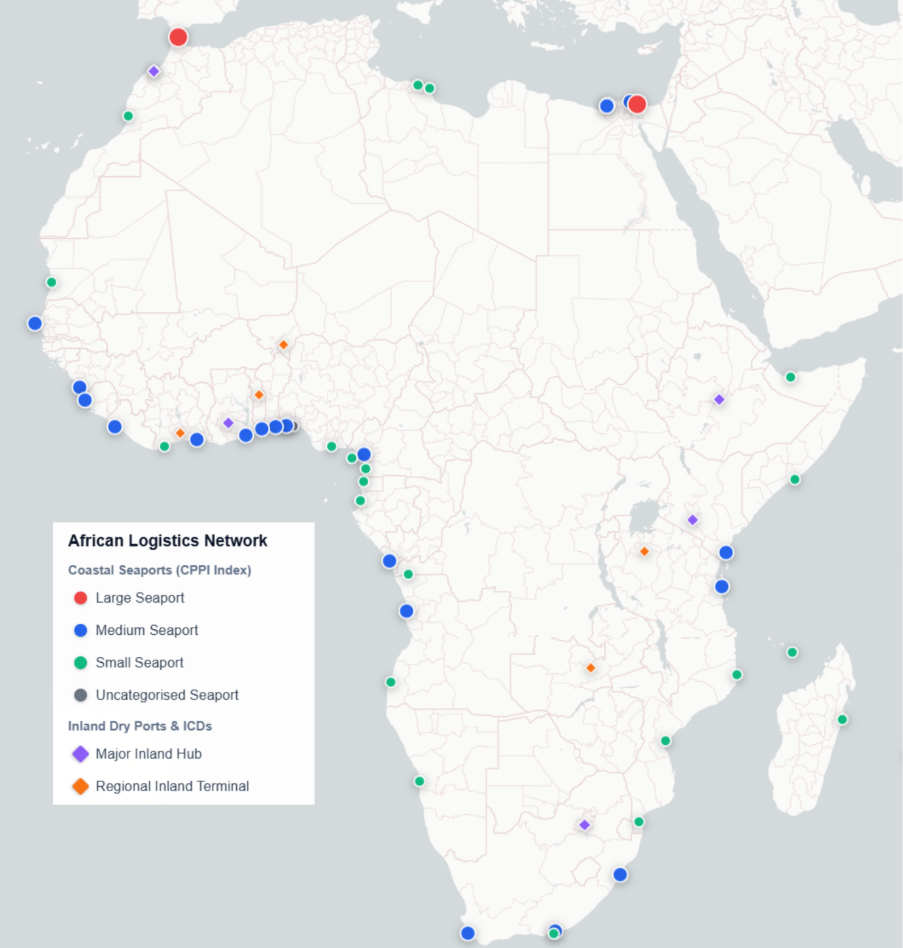
The Central African Copperbelt is a great example of this. Stretching across Zambia and the Democratic Republic of Congo, it is one of the greatest geological endowments on Earth, containing roughly 15 percent of global copper reserves and the overwhelming majority of known cobalt resources. On paper, it’s the heart of the global energy transition, but in practice, it sits thousands of kilometres from the nearest deep-water port (Figure 1). Every tonne of copper concentrate or cobalt hydroxide must cross borders, rail networks, highways, customs checkpoints and ports before reaching global markets.
Guinea’s Simandou iron ore project is another example. To overcome the regional bottlenecks that kept Simandou buried for decades, a massive twenty-billion-dollar joint venture involving Chinese firms stepped in. They didn’t just buy the rights to dig (which they did) they built an entire, integrated logistics universe, including a multi-hundred-kilometre heavy-haul railway and the custom-built deep-water port of Morabaya, completely bypassing the clogged capital of Conakry altogether. The entire physical architecture was created, financed, and laid down with a single objective in mind. To feed the Chinese industrial machine.
Without that corridor, Simandou remains stranded capital, but with it, those who financed the tracks and the ports gain de facto control over the minerals without ever needing to own the land.
Mirage sovereignty and the weaponization of logistics
This distinction between ownership and control is becoming increasingly important. As the EU’s Critical Raw Materials Act vividly exemplifies, Governments tend to assume that if minerals lie beneath their territory, they ultimately control their destiny. Those who live and work in African mining jurisdictions will know that, in reality, sovereignty over the resource does not necessarily translate into sovereignty over the supply chain.
If every railway is designed to move raw materials towards a foreign-owned export terminal, and every shipping contract is structured around overseas refining capacity, then domestic policy options quickly fall apart. When a government does not control its own trade, local attempts at “resource nationalism” (like imposing export tariffs on raw ore or mandating local refining) become painfully fragile.
Several governments have attempted to retain the value from their mineral resources by restricting exports of unprocessed materials. Zimbabwe banned exports of raw lithium, Mozambique introduced restrictions on graphite exports, and the Democratic Republic of Congo has banned copper and cobalt concentrate exports to encourage greater domestic value addition.
Yet these well-intentioned domestic policies tend to run aground when an export ban means very little if the country’s entire logistical spine is owned and operated by the very foreign entities you are trying to restrict. You simply cannot build a processing industry overnight if every kilometre of railway, every export terminal and every logistics corridor has been designed to move raw material overseas as quickly as possible. Infrastructure creates path dependency, and once those pathways are established, it’s a web that tightens the more you struggle.
Three lenses of control
To fully appreciate how thoroughly Western strategists have misread this geopolitical landscape, it helps to view the situation through three distinct lenses.
Structural Closure: I’ve discussed this in previous pieces. Resource dominance is not a snapshot of present-day market share, but a result of long-term, structural investments that become unmovable over time. This is particularly the case when a foreign entity builds a twenty-billion-dollar logistics corridor, creating permanent control of the structural openness of that market. Competing buyers are not simply competing on price, they are competing against infrastructure that was deliberately built to favour someone else.
Fractured Networks: Modern transport networks should be expected to strengthen regional trade by linking neighbouring economies together, connecting regional commerce and internal strength. Yet, the nature of Africa’s maritime and rail trade actively prevents this integration. They are clearly one-sided, built for the southbound movement of manufactured goods and the northbound movement of raw minerals. Because there is very little regionally localised trade in finished goods, commercial shipping lines basically have no financial incentive to establish routes between neighbouring African ports. So instead of unifying the continent, external infrastructure projects fracture it, pulling different regions into competing foreign economic orbits.
Dual Use: In an era of growing geopolitical competition, the boundary between commercial infrastructure and military capability becomes blurred. Those who control the deep-water ports and the rails, hold the power to limit rival supply chains at a moment’s notice. This is particularly visible in Djibouti’s Doraleh Multipurpose Port, for which China funded 85%. And by no means is this the only one, with Chinese interests also eyeing Myanmar, Pakistan, Seychelles, Sri Lanka and Tanzania. By leveraging this debt, Beijing secured exclusive use of large deep-water berths designed for heavy naval deployment. And yet China is not the only one doing this. In fact, this strategy of foreign dual-use ports is a non-Chinese concept and is also used by the likes of the United States, France, and other European powers. What is key, however, is the financial and legal mechanisms used to achieve this, with Beijing overwhelmingly avoiding political friction where possible, choosing the carrot rather than the stick.
Winning the terminal, not the map
If critical minerals are the backbone of the global economy, logistical superiority is the muscle that determines when, where, and how that backbone can move.
The next generation of supply chain competition will not be decided solely by discovering larger deposits or approving more mining permits. It will be decided by who finances the railways, secures the ports, operates the shipping corridors and integrates those assets into processing capacity.
None of this, however, should be interpreted as a simple story of winners and losers. As many Africans will tell you, China’s infrastructure investments are viewed through a very different lens than what Western media portrays. Whatever one’s view of Beijing’s strategic ambitions, it is difficult to ignore the fact that it has been willing to finance infrastructure on a scale that few others have matched.
This alone complicates the geopolitical narrative. These investments are not simply transactions. They are shaped by history, development priorities and long-standing frustrations with Western engagement. For many governments, the question is not whether China is an ideal partner, but whether there was another partner prepared to build at the same pace or scale.
Mines can change ownership. Commodity prices can collapse. Governments can be voted out. But ports, railways and shipping corridors endure for generations. They shape trade long after today’s governments and mining companies have disappeared. Until the West aligns their capital to build, secure, and operate the infrastructure, they will continue to lose the race for the future.
You can write all the policy white papers you want, but if someone else owns the route to market, you are simply paying for their leverage.
Nicholas Vafeas is the founder and director of BluMelt Mineral Consulting Limited, an independent consultancy specializing in geological assurance, critical minerals and investment de-risking.


